MBMC Mini-Cluster Redevelopment PMC | RightWay PMC
  • MahaRERA Registered
  • ISO 9001:2015 Certified
  • 12+ Years in MBMC

Mini-Cluster Redevelopment Builder-Neutral PMC Advisory

Capitalize on the state government's new 2,500 sq.m. amalgamation framework. We execute mathematical feasibility models, drive multi-society consensus, and navigate UDCPR compliance to ensure your cluster secures the maximum 4.0 FSI cap without builder manipulation.

  • 2,500 sq.m.
    Amalgamation Planning
  • 4.0 Statutory
    FSI Cap Optimization
  • Multi-Society
    Consensus & Governance
Cluster Redevelopment — Regulatory Overview | RightWay PMC
UDCPR Chapter 14 Regulatory Shift

Understanding the MBMC
Mini-Cluster Framework
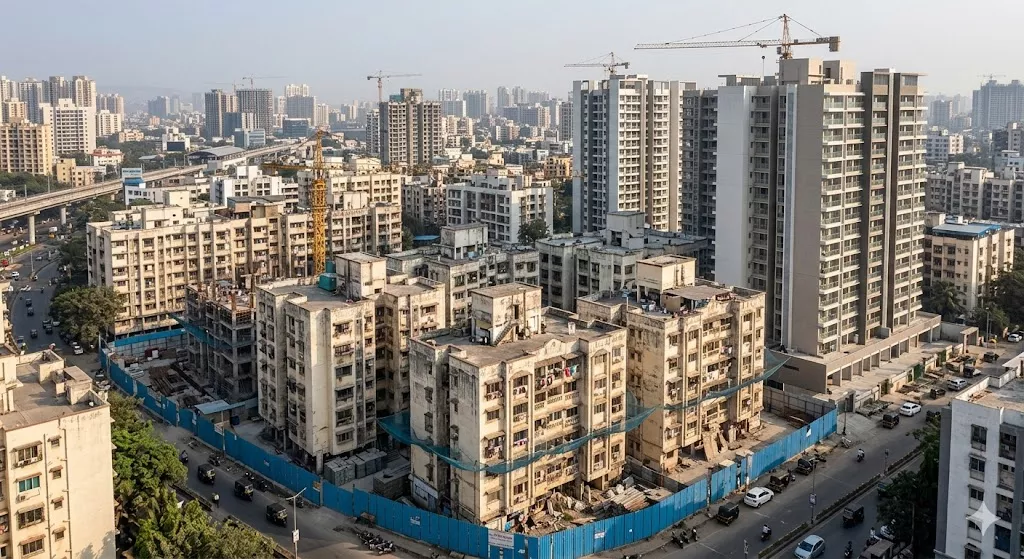
Cluster redevelopment residential buildings managed by RightWay PMC
20+ Societies in
Advisory

The Maharashtra State Urban Development Department has formulated a targeted "Mini-Cluster" redevelopment scheme, functioning effectively as a "cluster within a cluster" framework[cite: 1]. Operating under Chapter 14 of the Unified Development Control and Promotion Regulations (UDCPR), this scheme provides a highly specific legislative solution to the fragmented housing crisis within the MBMC jurisdiction[cite: 1].

Historically, achieving the 4,000 square meter consensus required for standard urban renewal benefits was an insurmountable barrier for isolated properties[cite: 1]. The newly amended framework decisively lowers this threshold, allowing fragmented plots to amalgamate and pool their setback requirements to achieve massive architectural efficiency[cite: 1].

Mini-Cluster Legislative Parameters
  • Strict requirement to amalgamate a minimum of five distinct, existing buildings[cite: 1].
  • Reduced minimum qualifying area for a redevelopment cluster down to 2,500 square meters[cite: 1].
  • Mandates that the amalgamated plot must have access to an 18-meter Development Plan (DP) road[cite: 1].
  • Unlocks a 0.5 Incentive FSI, propelling the total maximum permissible composite limit to 4.0[cite: 1].
Cluster Redevelopment — FSI Mathematical Comparison | RightWay PMC
The Mathematical Mechanics of FSI

Standalone Constraints vs.
Cluster Amalgamation Value

The addition of a flat 0.5 Incentive FSI under the MBMC Mini-Cluster policy pushes the total composite limit to 4.0[cite: 1]. This mathematical shift dramatically alters project viability, builder profit margins, and the resulting surplus corpus allocated to your society members[cite: 1].

Standalone Redevelopment
Available Redevelopment FSI
Severely constrained by plot geometry and required parking setbacks. Typically maxing out at a 2.5 to 3.0 limit[cite: 1].
Additional Carpet Area & Corpus
Marginal increase (often only 10% - 20%). Corpus is minimal to zero due to incredibly low builder financial viability on highly constrained 1980s layouts[cite: 1].
Open Space & Amenities
Negligible. Societies are left with fragmented strips of mandated green space that provide little to no lifestyle value[cite: 1].
Cluster Amalgamation (2,500 sq.m)
Available Redevelopment FSI
Ground-level efficiency allows for podium parking, freeing the vertical footprint to be maximized up to the 4.0 statutory cap[cite: 1].
Additional Carpet Area & Corpus
Significant expansion. Economies of scale and the 0.5 incentive FSI drive a substantial surplus corpus derived from the developer's expanded sale component ratio[cite: 1].
Open Space & Amenities
Consolidated and luxurious. Allows for large-scale amenities such as clubhouses and centralized parks[cite: 1].
Mini-Cluster Eligibility Checker | RightWay PMC
Feasibility Calculator

Check Your Mini-Cluster
Eligibility Instantly

The state government's Mini-Cluster scheme is highly specific. To prevent exploitation by standalone plots, the Maharashtra Urban Development Department (UDD) requires specific spatial and infrastructural criteria to qualify for the highly lucrative 0.5 Incentive FSI[cite: 1].

  • Amalgamation of a minimum of five distinct, existing buildings[cite: 1].
  • Minimum contiguous land area of 2,500 square meters[cite: 1].
  • Direct access to a Development Plan (DP) road with a minimum width of 18 meters[cite: 1].

0.5 Incentive FSI Checker

Enter approximate details for immediate feedback

Cluster Redevelopment — Visual Proof Gallery | RightWay PMC
Incontrovertible Evidence

Institutional-Grade Deliverables

Fiduciary responsibility demands empirical proof, not qualitative promises. We execute rigorous mathematical models, builder-neutral legal structures, and relentless execution audits to safeguard your cluster[cite: 1].

Redacted Financial Viability and FSI Model
Stage 02 Deliverable

Mathematical Feasibility & FSI Models

We generate complex financial viability models projecting exact construction costs versus developer revenue, ensuring the societies know the exact mathematical value of their combined land before entering negotiations[cite: 1].

Redacted Airtight Development Agreement
Stage 03 Deliverable

Airtight Development Agreements (DA)

We deploy objective comparative analysis matrices to select the most capitalized developer, followed by structuring airtight agreements that completely isolate the societies from financial and legal liabilities[cite: 1].

Redacted Concrete Grade and MEP Audit Report
Stage 05 Deliverable

Site Vigilance & QC Audits

We eliminate substandard engineering practices by verifying concrete grades, monitoring MEP design compliance, and enforcing uncompromising on-site quality control oversight[cite: 1].

Cluster Redevelopment — Urban Necessity | RightWay PMC
The Mira-Bhayandar Context

Why Amalgamation Is a
Structural Necessity Today

During the late 1970s and early 1980s, the Mira-Bhayandar region was governed merely by a gram panchayat, resulting in haphazard construction driven by the Urban Land Ceiling (ULC) Act[cite: 1]. Because there was no formal Development Plan (DP) enforced, the architectural legacy is a sprawling urban fabric populated by densely packed structures[cite: 1].

Today, the redevelopment of these isolated, small-plot buildings on a standalone basis is frequently rendered architecturally impossible and financially unviable under strict modern mandates[cite: 1].

Overcoming UDCPR Setbacks

Modern safety and planning mandates under the UDCPR 2020 require stringent boundary setbacks and mandatory recreational open spaces[cite: 1]. When applied to a fragmented 1980s plot, these regulations consume the ground footprint, making new construction fundamentally unfeasible[cite: 1].

Unlocking Podium Parking

Standalone aging buildings cannot accommodate modern parking mandates without sacrificing saleable FSI[cite: 1]. By amalgamating 2,500 square meters, societies pool their open spaces, creating enough ground-level efficiency to construct multi-level basement or podium parking[cite: 1].

Consolidating Civic Amenities

When attempting standalone redevelopment, plots are left with negligible, fragmented strips of mandated green space[cite: 1]. A unified cluster consolidates these requirements into large-scale amenities, clubhouses, and centralized parks[cite: 1].

Achieving the 4.0 FSI Cap

Standalone plots are constrained by geometry, typically maxing out at a 2.5 to 3.0 FSI limit[cite: 1]. Amalgamation frees up the vertical footprint to fully consume the 4.0 statutory cap, driving significant expansion in the developer's sale component and the society's additional carpet area[cite: 1].

Cluster Redevelopment — Governance Framework | RightWay PMC
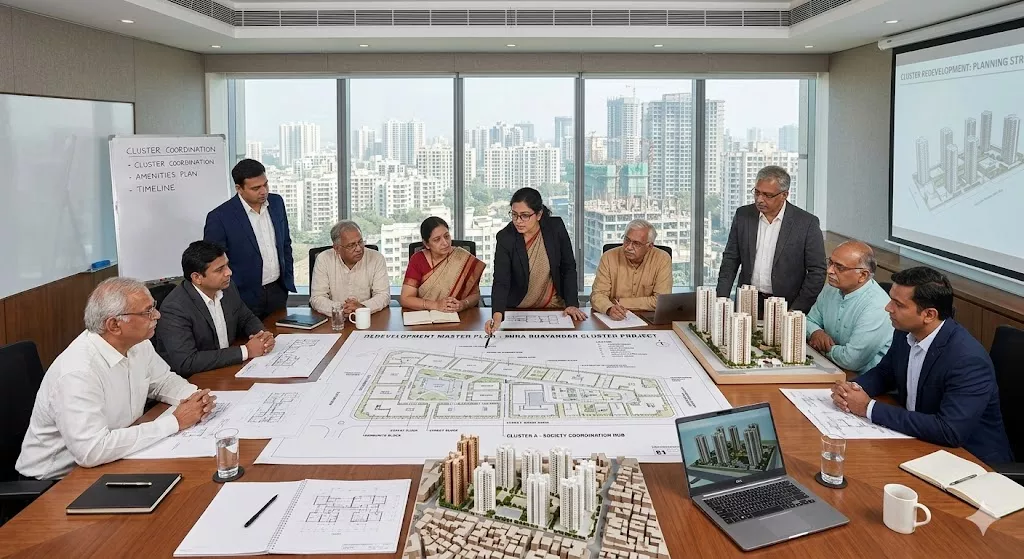
Redevelopment planning meeting between society members and PMC consultants
100% Society-Side Representation
Fiduciary Project Management

Mitigating Consensus Friction Through
Builder-Neutral Advisory

Redevelopment in Maharashtra is strictly governed by Section 79A of the Maharashtra Cooperative Societies Act[cite: 1]. In a cluster scenario, achieving a unified 51% consensus across five or more independent buildings is a monumentally delicate sociological task[cite: 1]. Failure to document this consent accurately often leads to catastrophic project delays and formal litigation before the Registrar[cite: 1].

RightWay PMC operates strictly on a builder-neutral, fiduciary basis, providing 100% society-side representation[cite: 1]. We hold no financial stake in the developer's eventual profit and accept no hidden referral fees[cite: 1]. Every technical and financial recommendation is made solely to protect the collective interests of your society members from predatory manipulation[cite: 1].

Stage 01
Land & Regulatory Assessment

Conducting precise net plot area verification and base/premium FSI entitlement analysis across all distinct land parcels[cite: 1].

Stage 02
Technical Feasibility & FSI

Generating complex financial viability models and estimating exact construction costs versus developer revenue[cite: 1].

Stage 03
Builder Evaluation & Agreement

Publishing unified tenders, conducting severe financial due diligence, and structuring airtight Development Agreements (DA)[cite: 1].

Stage 04
Execution Monitoring

Implementing strict escrow monitoring and quarterly progress audits to prevent financial misallocation and halts[cite: 1].

Stage 05
Compliance & QC Oversight

Executing on-site vigilance, verifying concrete grades, monitoring MEP compliance, and coordinating OC acquisition[cite: 1].

Cluster Redevelopment — Pre-Construction Legal Mastery | RightWay PMC
Pre-Construction Realities

Navigating the 18 to 36 Month Planning & Approvals Phase
A multi-society cluster project typically requires 18 to 36 months for planning and approvals before the additional 3 to 5 years for actual physical construction[cite: 1]. Developers notoriously issue unrealistic timeline promises to win bids, obscuring the reality of these procedures[cite: 1].

The pre-construction phase demands a protracted timeline because it involves incredibly dense legal and technical maneuvers[cite: 1]. Without rigorous, specialized intervention to clear these bottlenecks, your project risks devastating stagnation[cite: 1].

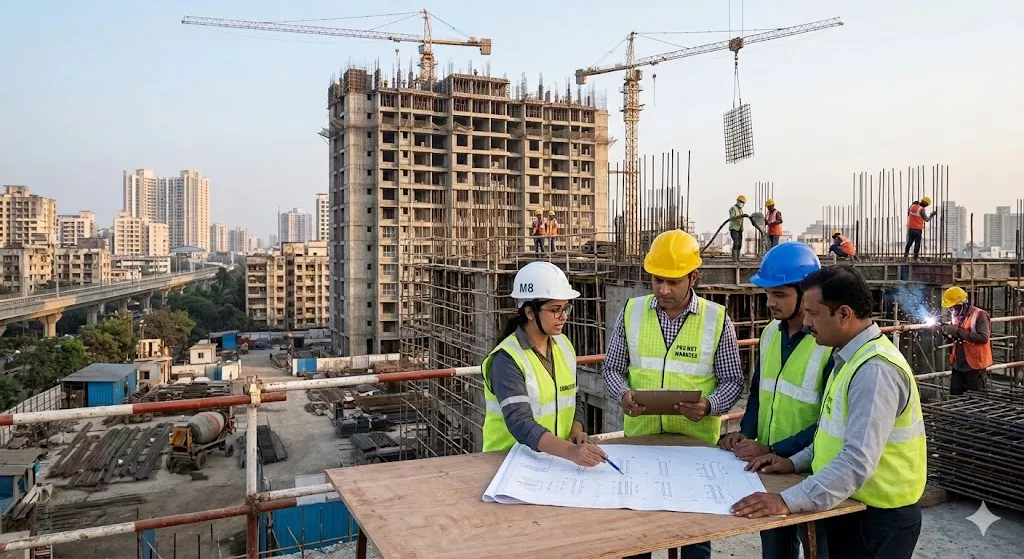
Project managers and engineers reviewing cluster redevelopment construction plans
Boundary Amalgamation

Executing the legal property card mutation processes required to legally merge disparate layouts into a single, cohesive land parcel[cite: 1].

Deemed Conveyance

Securing unilateral deemed conveyance execution to ensure all participating societies possess indisputable land title rights[cite: 1].

Environmental Clearances

Navigating complex administrative protocols to secure critical specialized environmental clearances and mandatory Fire Department approvals[cite: 1].

DP Road & Drainage NOCs

Mitigating Development Plan (DP) road widening impacts while securing the localized drainage NOCs necessary for massive structural loads[cite: 1].

Cluster Redevelopment — Why RightWay PMC
Absolute Fiduciary Duty

Why Housing Societies Choose
RightWay PMC

We operate strictly on a fiduciary basis, providing 100% society-side representation[cite: 1]. We hold no financial stake in the developer's profit and accept no hidden referral fees, ensuring every technical recommendation protects your members from predatory manipulation[cite: 1].

Builder-Neutral Advisory

We work exclusively on behalf of the housing society, shielding your committee members from developer influence and ensuring absolute impartiality during negotiations[cite: 1].

MahaRERA Compliance

Our governance framework ensures mandatory quarterly progress updates are executed perfectly, avoiding heavy monetary penalties and MahaRERA interventions[cite: 1].

Institutional Track Record
12+
Years in MBMC
30+
Active Projects
100%
Society-Side Focus

Escrow Financial Oversight

We implement strict escrow monitoring alongside routine financial audits to prevent capital misallocation and dangerous cash-flow halts[cite: 1].

Defect-Free Execution

Executing relentless on-site vigilance to verify concrete grades and monitor MEP compliance up until the final Occupancy Certificate (OC) acquisition[cite: 1].

Cluster Redevelopment FAQ | RightWay PMC
Common Questions

Frequently Asked Questions on
Cluster Redevelopment

Housing societies considering cluster redevelopment often have questions about the process, timelines, approvals, and the role of a Project Management Consultant. We have answered the most common ones below.

Cluster redevelopment in the MBMC jurisdiction operates under the specialized "Mini-Cluster" scheme, drafted by the Maharashtra State Urban Development Department under UDCPR Chapter 14[cite: 1]. This framework functions as a "cluster within a cluster," reducing the minimum qualifying area to a highly achievable 2,500 square meters[cite: 1]. To qualify, it requires the amalgamation of a minimum of five distinct, existing buildings with access to an 18-meter Development Plan (DP) road[cite: 1].
Societies should opt for amalgamation when standalone plots face stringent boundary setbacks and mandatory recreational open spaces under the UDCPR 2020, which consume so much of the ground footprint that new construction becomes fundamentally unfeasible[cite: 1]. Pooling land creates enough ground-level efficiency to construct multi-level basement or podium parking, while unlocking a 0.5 incentive FSI, pushing the total maximum permissible composite limit to a 4.0 cap[cite: 1].
A Project Management Consultant provides a "Builder-Neutral Advisory" stance, operating strictly on a fiduciary basis to provide 100% society-side representation[cite: 1]. The firm holds no financial stake in the developer's eventual profit and accepts no hidden referral fees, ensuring that every technical and financial recommendation is made solely to protect the collective interests of the society members from predatory manipulation[cite: 1].
A cluster project typically requires 18 to 36 months for planning and approvals, followed by an additional 3 to 5 years for actual physical construction[cite: 1]. This protracted pre-construction phase is necessary because it involves incredibly dense legal and technical maneuvers, including boundary amalgamation and unilateral deemed conveyance execution[cite: 1].
Redevelopment in Maharashtra is strictly governed by Section 79A of the Maharashtra Cooperative Societies Act, which requires achieving a 51% member consent requirement simultaneously across all independent properties[cite: 1]. Following this, the project faces specific bottlenecks such as the necessity of securing Fire Department clearances, localized drainage NOCs, and mitigating Development Plan (DP) road widening impacts[cite: 1].
RightWay PMC utilizes a rigorous five-stage structural governance framework explicitly adapted to the unique demands of multi-society amalgamation[cite: 1]. This includes land and regulatory assessment to establish a neutral baseline of total development potential, preventing developers from lowballing the cluster's true worth, and utilizing objective comparative matrices during builder evaluation[cite: 1].
Have a question not covered here?
Speak directly with our PMC team.
Confidential advisory for housing societies in Mira Road & Bhayandar. No obligation.
Scroll to Top